 Slync
Slync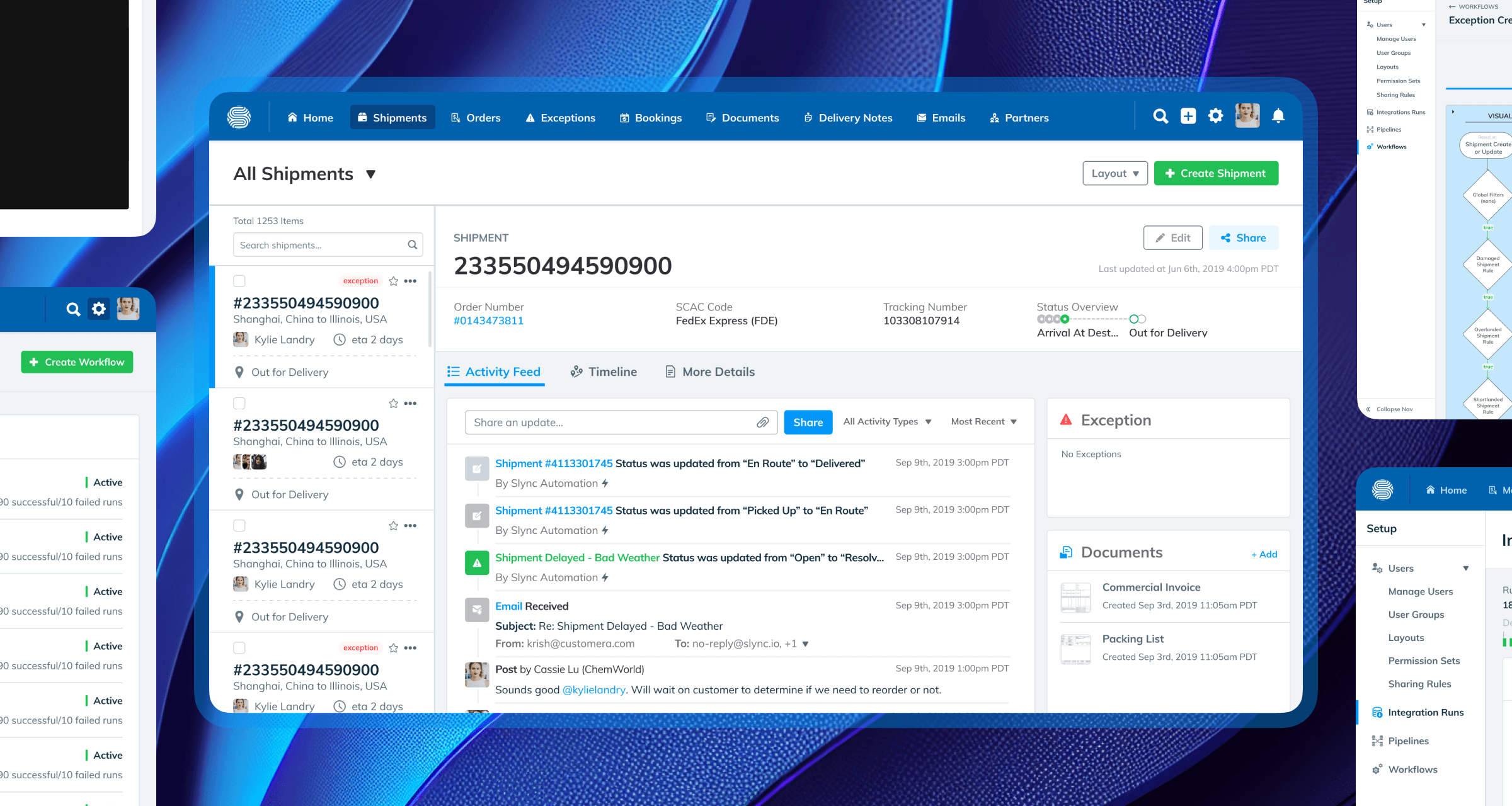
Skills: UX research, wireframing, Figma prototyping, fit-and-finish
Target persona: Freight forwarding professionals looking to gain visibility, add intelligence, and collaborate on their various shipments
Background
Slync was founded in 2017 to tackle the legacy software used in the supply chain. The first attempt began as a track-and-trace tool built on the Hyperledger blockchain. We quickly pivoted due to Hyperledger's speed and relative nascency. From there, we worked full-sprint to build our metadata platform from scratch to support the collaboration and speed required by complex supply chains. The video you see above is the product of Series A. Below are the various Figmas of features all developed in-house by myself as a sole designer.
Activity feed
Allow admins to view the complete lifecycle of an object — from creation to exchanging partners to being delivered. This heterogeneous list elegantly shows all changes and records based on timestamp: posts, emails, status changes, and related record creation (exceptions, parent object, child objects).
Map view
View shipments on a map view based on geo-data that is ingested into the Slync platform through integrations. This was useful for our customers to visualize their shipments and then surface this to their end users.
Setup
Allow admins and users to configure the metadata for the platform. This included a robust permission model, integrations, and workflows.
Files experience
View all of the various supply chain space documents digitized and shown in Slync. Documents are frequently used in supply chain processes but are very rarely surfaced alongside the shipment itself. They are typically lost in long email threads and then difficult to search. The Slync platform allowed you to view the document within the context and search amongst your larger corpus.
Outcome & reflection
Slync raised a $25m series A round from Blumberg Capital, Correlation Ventures, and 235 Capital Partners. I departed Slync after the round was completed. Slync is still actively working towards the original mission of providing transparency in global chains.
Skillsets used
- Rapidly iterating on wireframes and sketches based on a product vision
- Delivering a high-fidelity Figma prototype with complete interactivity and end-to-end flows
- Working with engineering and product teams to deliver product specs that can be leveraged by engineers
- Contributing to web app and mobile development for the final polish of designs (CSS + React)
- Working closely with an internal solutions teams and external users to gather research