 Therefore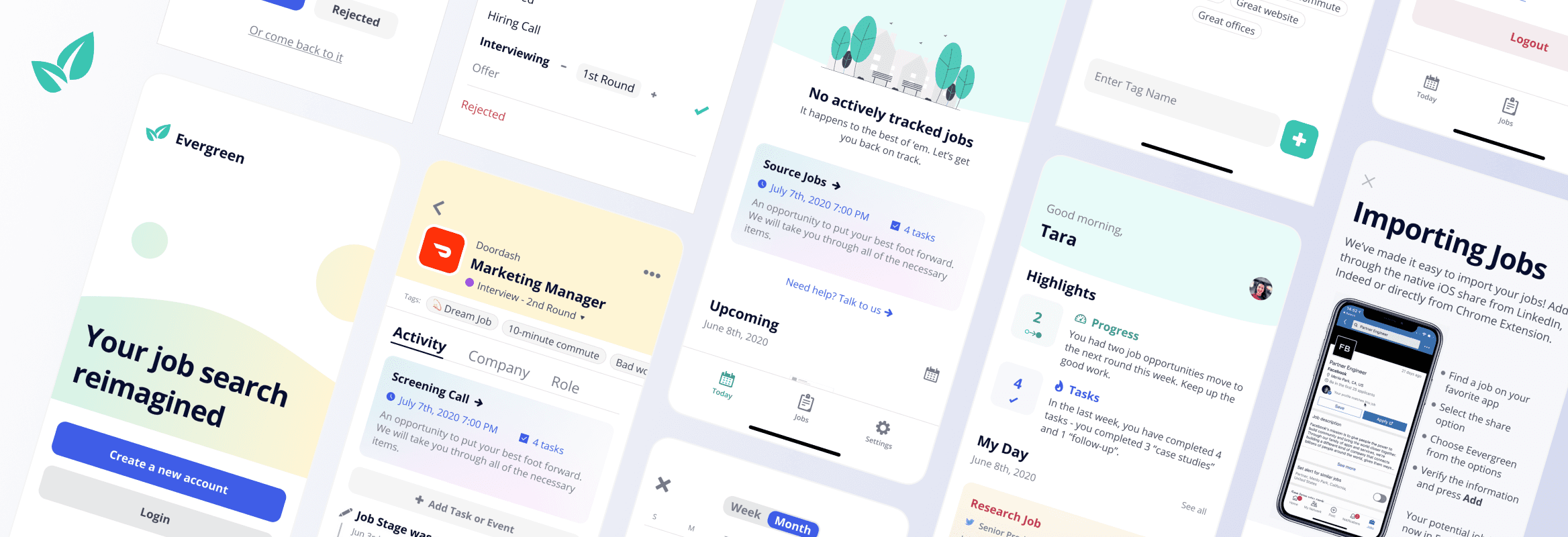
Skills: UX research, wireframing, Figma prototyping, mobile development, fit-and-finish
Target persona: Job seekers struggling to track their applications and conversations in their job search
Background
The Evergreen app (react-native) was built for job seekers to track their complete job search process and motivate them along the way.
Before we set out developing this app, we spent time identifying the life span of a job seeker from exiting a previous role to finding their next one (see below).
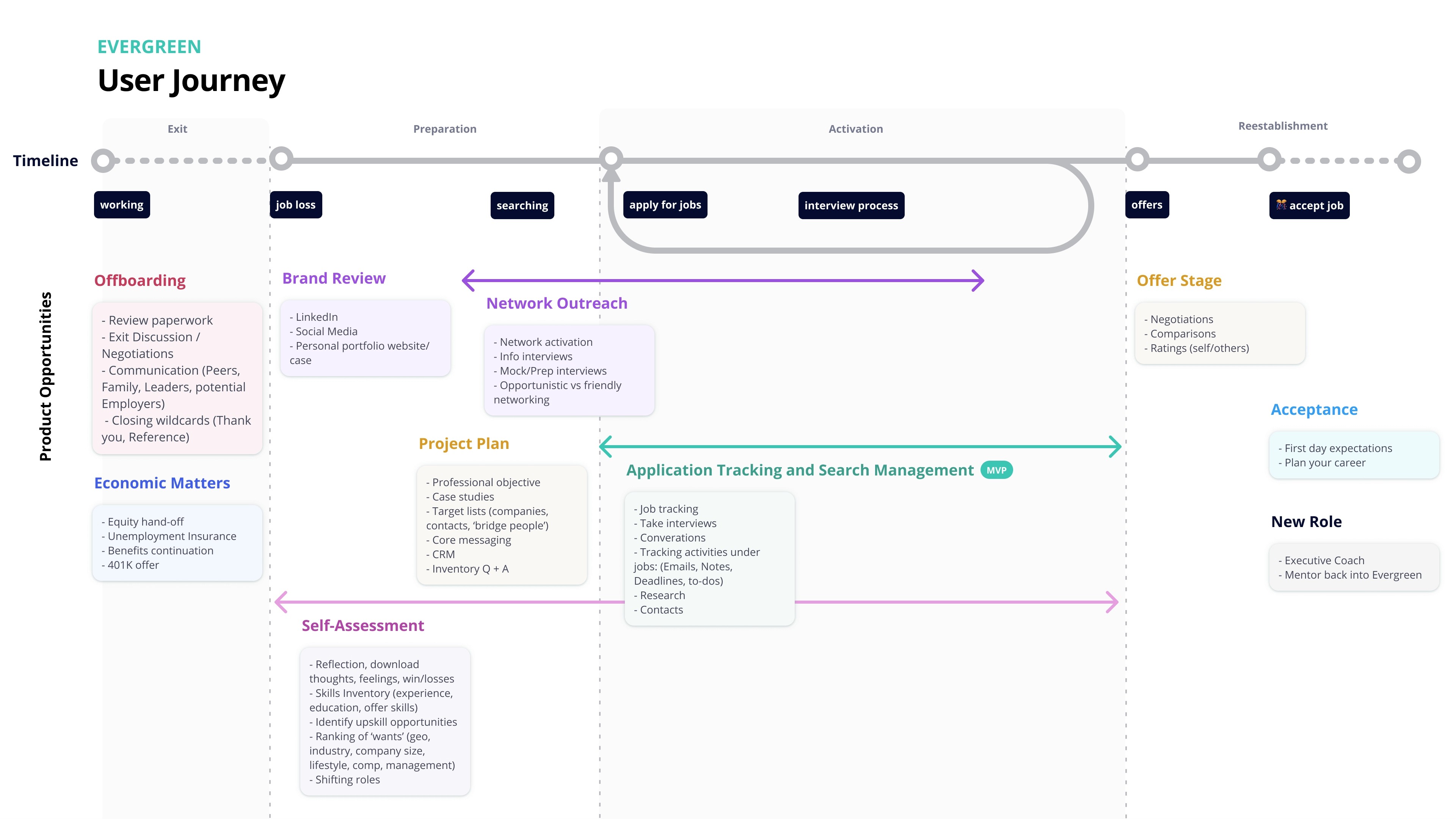
There's a lot to tackle here for job seekers — it's an exceptional time of uncertainty for even the most experienced.
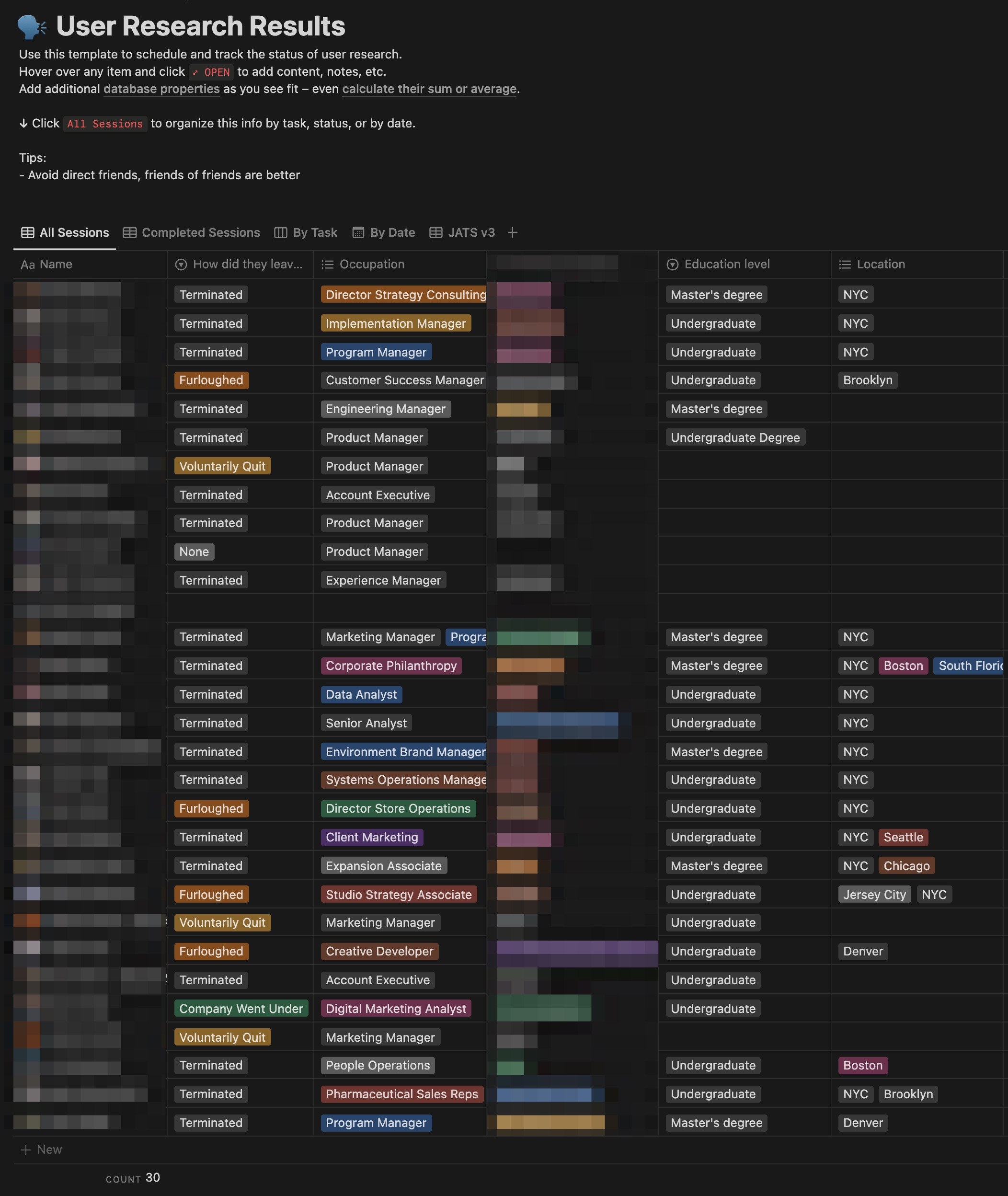
Thankfully, we had an excellent UX researcher in-house, Lillie Leone. Together we set out to hear directly from these job seekers, we spent 2 weeks interviewing as many job seekers as possible. In total, we talked to 31 people ranging across different occupations and education levels (see below).
We learned that the most immediate pain point was properly tracking your job search. The best job seekers would have meticulous notes and matrices organized into drive folders. They would continuously tweak them throughout their search. The less diligent job seeker would take notes in a notebook or their computer.
This led to:
- Job seekers feeling overwhelmed by the number of applications and follow-ups.
- Job seekers frequently feeling that they were being ghosted by companies with no reason.
On the other side, every major company that is recruiting seriously has an Applicant Tracking System (ATS). These systems track every applicant, log emails/calls/notes, send reminders, push offer letters, and much more. They are the baseline for any serious recruiting team.
So we asked ourselves, why don't job seekers have the same? We called it the Job Application Tracking System (JATs).
Solution
We decided to build a native mobile app to ensure job seekers were engaged with on-the-go notifications and job search management.
We adopted a rigid two-week design sprint process.
- Day 1 to 3. Source our research candidates and create design prototypes.
- Day 3 to 6. Interview candidates.
- Day 6 to 8. Analyze and prep the results.
- Day 9. Present the findings to the larger team.
- Day 10. Prepare the dev specs for the engineering team by working closely with our incredible CTO, Beau Haugh, to begin building.
We ran 3 of these sprints and in a matter of two months had a robust app to deploy to the iOS app store and the Android play store.
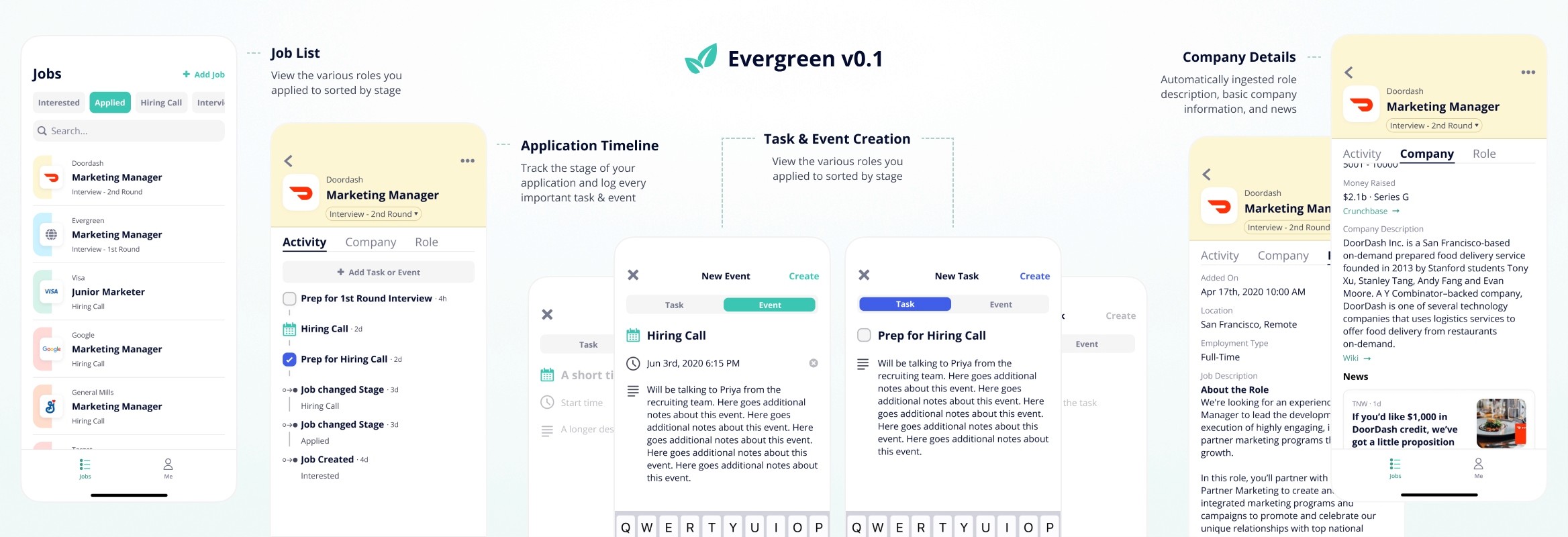
V1 - Import job application. Stages. Activity Log.
We designed and released the foundation for the app — allowing users to add jobs, log events/tasks, and pull in all the basic information of a company.
V2 - Evergreen actions. Prioritizing.
We immediately learned from our users that there were a set of tasks/actions that were being missed. They were either forgetting to do them or weren't aware of them. We started introducing these tasks automatically via our platform as, "Evergreen Actions". Some examples:
- Pitch Yourself
- Prep for Interview
- Sourcing Jobs
- and more!
And to ensure that these actions were not being missed, we added a robust notification engine to proactively warn job seekers.
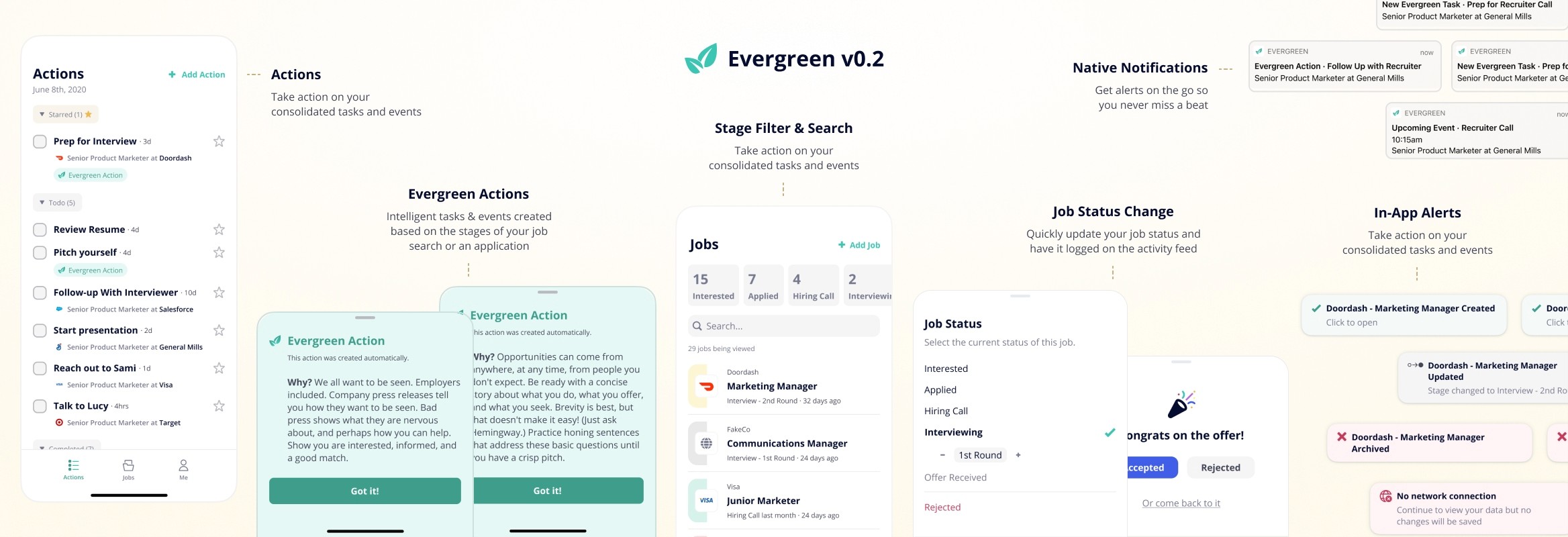
V3 - Improved home experience. Tag systems.
The next versions of the app continued to grow the app based on their requests. We built a chrome extension and an iOS share sheet feature to quickly import jobs.
From additional user research, we determined we needed to build an app that represented the "Noom" of your job search. We improved our home experience to include statistics, introduced clustered Evergreen Actions (think a series of steps that are recommended to take), and started publishing content to keep you motivated.
Lastly, we built a tag system that allowed users to tag jobs with criteria that were most important to them.
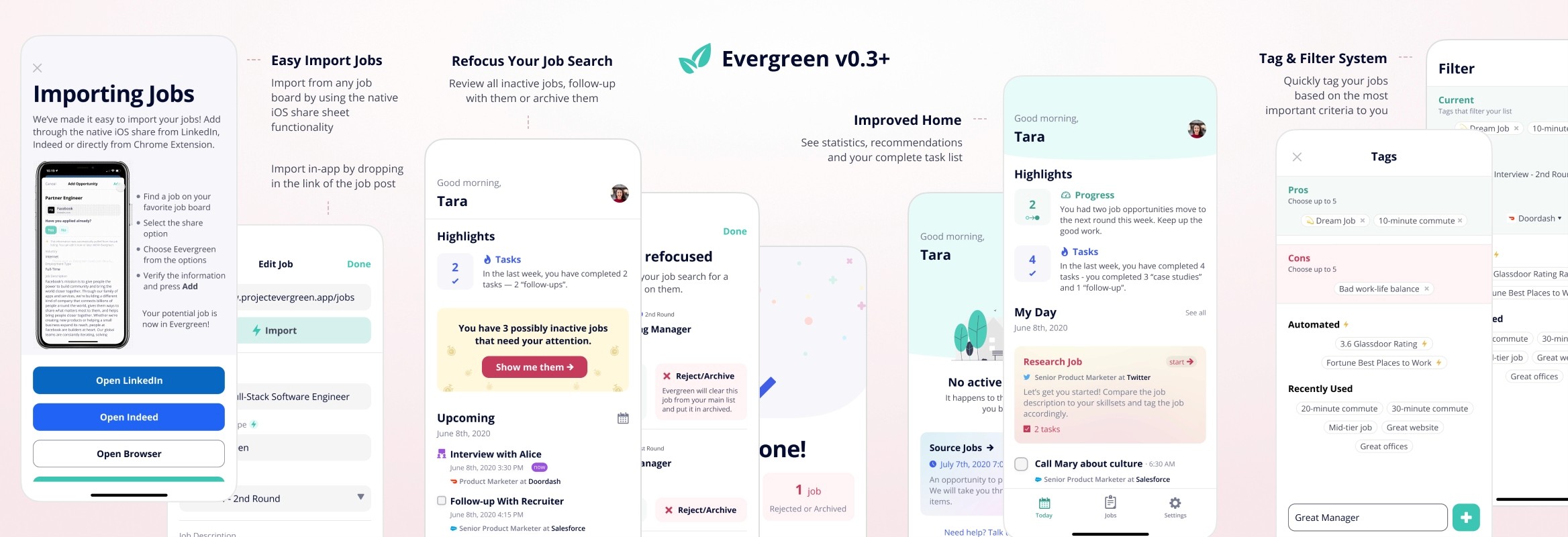
Outcome & reflection
After releasing these versions of the app (for around 4 months), we looked at the metrics and data we were gathering. Our beta users were adding jobs, and taking action but there was a clear issue emerging from their job process. A large percentage of our users were mass-applying to jobs (adding more than 40 a week). They would apply to as many as they can and hope that some would convert.
We believed that this was an incorrect approach to the job search. Instead, we think the best job search should be conducted methodically by leveraging your network.
That led us to build the next version of Evergreen, a networking program based product with a new brand in collaboration with Red Antler, Therefore.
Skillsets used
- Working closely with a UX Researcher to gather research and take product actions on it
- Rapidly iterating on wireframes and sketches of a mobile app based on a product vision
- Delivering a high-fidelity Figma prototype with complete interactivity and end-to-end flows
- Working with engineering and product teams to deliver product specs that can be leveraged by engineers
- Contributing to web app and mobile development for the final polish of designs (CSS + React)